Support
USD/CAD forecast: can the Canadian dollar rally after the BoC decision?
The Canadian dollar has found some support ahead of Wednesday’s Bank of Canada decision, but its ability to extend those gains may depend more on what happens in Washington than on the expected rate hike in Ottawa.
BoC widely expected 25-basis-point hike puts the focus on what comes next.
December rate expectations could offset Canadian dollar gains.
Potential tariff relief may reshape Canada’s growth and inflation outlook.
A sustained break above 1.4300 would strengthen the bullish case.
The rate decision is only the first test
The Bank of Canada is widely expected to raise its benchmark interest rate by 25 basis points to 2.50%, following a period of unchanged rates. September inflation reached 3.1%, while retail sales rebounded by 1.2% in August, suggesting Canadian consumers have remained more resilient than policymakers might have expected. Together, these figures have reduced the argument for keeping rates unchanged, particularly as higher energy costs threaten to keep inflation elevated.
However, stronger spending creates a complication for the Bank of Canada. While resilient consumption gives policymakers greater confidence that the economy can withstand higher borrowing costs.
It also raises the possibility that inflation will take longer to return to target. The central bank must therefore decide whether Wednesday’s increase is enough to contain those pressures or whether additional tightening may be necessary.
That distinction for USD/CAD because investors have already largely anticipated a 25-basis-point hike. The Canadian dollar would likely need a stronger signal about future policy to sustain its recent gains, especially with the Fed expected to maintain a considerably higher interest rate.
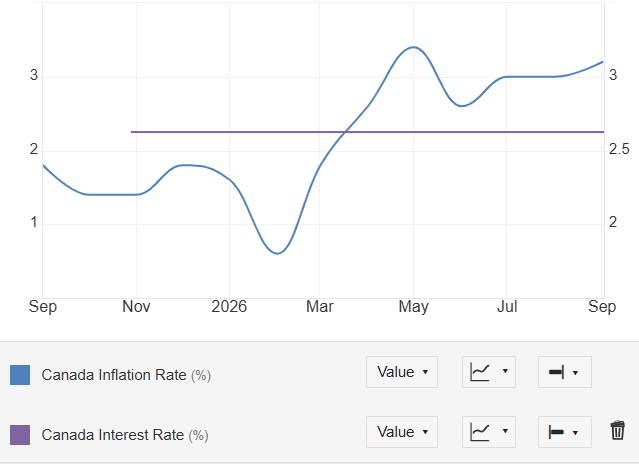
Source: Statistics Canada
The Fed could limit the Loonie upside
The Fed is expected to leave its benchmark rate unchanged, but the decision may do little to settle the outlook for December. Markets are pricing roughly an 80% probability of another increase, reflecting concerns that elevated energy costs could prolong inflation pressures. If policymakers reinforce those concerns, the US dollar could retain support even as the Bank of Canada tightens.
This creates an uncomfortable situation for the Canadian dollar
A rate increase in Canada would ordinarily narrow the interest-rate gap with the United States, but that advantage could disappear if investors become more convinced that the Fed will tighten again. In other words, Wednesday’s decisions may matter less than how expectations for the next meetings change afterward.
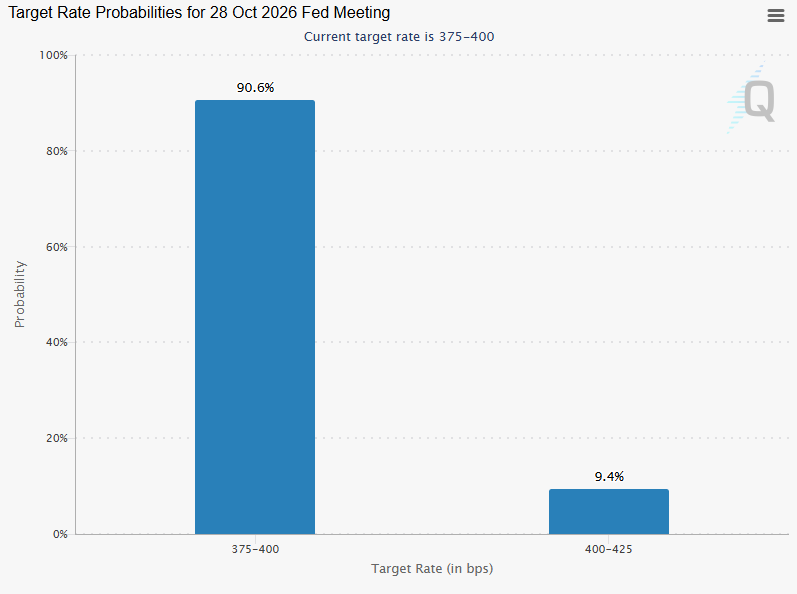
Source: CME Group
Tariff talks complicate the policy outlook
Washington and Ottawa are reportedly discussing an agreement to ease tariffs on Canadian steel and automobiles before the November 3 US midterm elections. The negotiations involve steel tariffs of up to 50% and automobile duties of 25%, although Washington is seeking additional concessions from Canada.
For Canadian businesses, uncertainty over access to the US market has made it difficult for manufacturers to plan investment, expand production and make long-term hiring decisions. Reducing that uncertainty could encourage companies to resume spending that has been delayed, improving the outlook for employment and economic activity.
The importance of a potential agreement extends beyond lower export costs
Yet an improvement in trade relations would not necessarily make the Bank of Canada’s job easier. Stronger business investment and household confidence could support growth at a time when policymakers are trying to contain inflation. On the other hand, lower trade barriers could ease some production costs and reduce pressure on company margins. Which effect dominates would influence how much additional tightening the Canadian economy requires.
If tariff relief is announced shortly after the central bank meetings, investors may need to reassess Canada’s growth prospects before the full economic impact becomes visible. That could provide support for the Canadian dollar independently of interest-rate expectations, particularly if the agreement is broad enough to improve confidence across the manufacturing sector.
Technical outlook
USD/CAD continues to trade within a broader recovery, with price holding above the rising trendline and the moving average near 1.3901. The sequence of higher lows suggests buyers are still willing to defend the advance, but the pair has yet to clear the resistance that matters most.
At 1.4300, the next move becomes clearer. A sustained break above this level would strengthen the bullish case, opening the way towards 1.4500 and potentially the previous high near 1.4690. Until then, the rally remains vulnerable to another rejection.
Failure to break higher could pull the pair back towards 1.3900. A deeper decline below 1.3732, particularly if it breaks the rising trendline, would weaken the recovery and bring the 1.3500–1.3550 area into view.
The bias remains bullish while USD/CAD holds above 1.3900, but buyers need a decisive break above 1.4300 to confirm stronger upside momentum. Without that confirmation, the pair remains caught between a recovery that has yet to break resistance and the risk of another pullback.
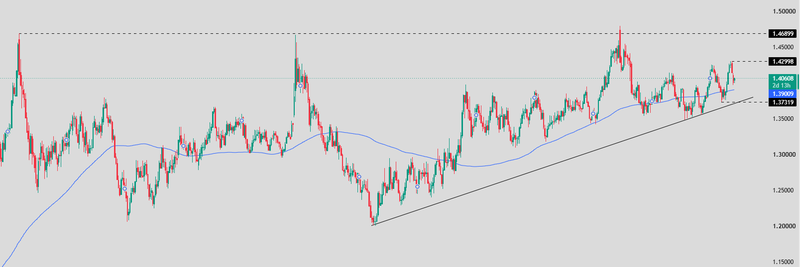
Source: Trading view